AeonScope insights is a sensing platform that captures time-series environmental and machine data. It records signals, timestamps them, and streams them to storage. The design aims to give engineers and analysts precise, continuous inputs for monitoring and model training. The introduction sets clear expectations about scope, common deployments, and core value. Readers will see how AeonScope operates and when it fits a project.
AeonScope is a modern digital platform designed to simplify data analysis, forecasting, and decision-making through advanced artificial intelligence and automation. It collects information from multiple sources, processes it using intelligent algorithms, and presents clear insights through interactive dashboards and reports. Businesses, researchers, and individual users can leverage AeonScope to identify trends, monitor performance, and make more informed decisions with less manual effort. In 2026, its growing focus on real-time analytics, user-friendly design, and customizable features makes it an attractive solution for organizations seeking efficiency and accuracy. However, whether AeonScope is right for you depends on your specific needs, budget, and technical requirements. If you value data-driven insights, automation, and scalable tools, AeonScope could be a worthwhile investment for improving productivity and strategic planning.
Key Takeaways
- AeonScope is a powerful sensing platform designed for precise, continuous capture of time-series environmental and machine data, ideal for engineers and analysts.
- Its layered architecture separates sensing, edge processing, and cloud storage, ensuring lossless buffering and strong timestamping for reliable data streams.
- AeonScope supports multiple hardware classes, from low-power loggers to high-speed capture cards, tailored to different industrial monitoring needs.
- The platform offers versatile connectivity and integrations, facilitating seamless data flow to common analytics and machine learning tools.
- Users benefit from improved anomaly detection and root-cause analysis with AeonScope’s synchronized timestamps and adaptive sampling features.
- Despite higher upfront costs and setup complexity, AeonScope delivers superior data fidelity and extensive metadata, making it valuable for teams needing high-integrity signal records.
What Is AeonScope? Origins, Purpose, And Core Concepts
AeonScope started as a lab project to improve long-term signal capture for industrial systems. The team built the first prototype to record low-frequency drift and high-frequency events with equal fidelity. The purpose evolved to serve operations teams that need continuous, labeled streams for analytics. Core concepts include time-synced sensing, edge preprocessing, and lossless buffering. AeonScope treats each data stream as a first-class asset. The system emphasizes predictable sampling, clear metadata, and traceable provenance for later analysis and model validation.
How AeonScope Works: Architecture And Technical Overview
AeonScope uses a layered architecture that separates sensing, edge processing, and cloud storage. The sensor layer captures raw signals. The edge node compresses and annotates data. The cloud layer stores and indexes time-series records. The system enforces strong timestamps and sequence IDs for each packet. Engineers deploy local agents that handle intermittent networks. The model allows for replay, tagging, and batch export. The architecture supports modular upgrades to sensors and connectors without changing core storage formats.
Core Components And Sensors
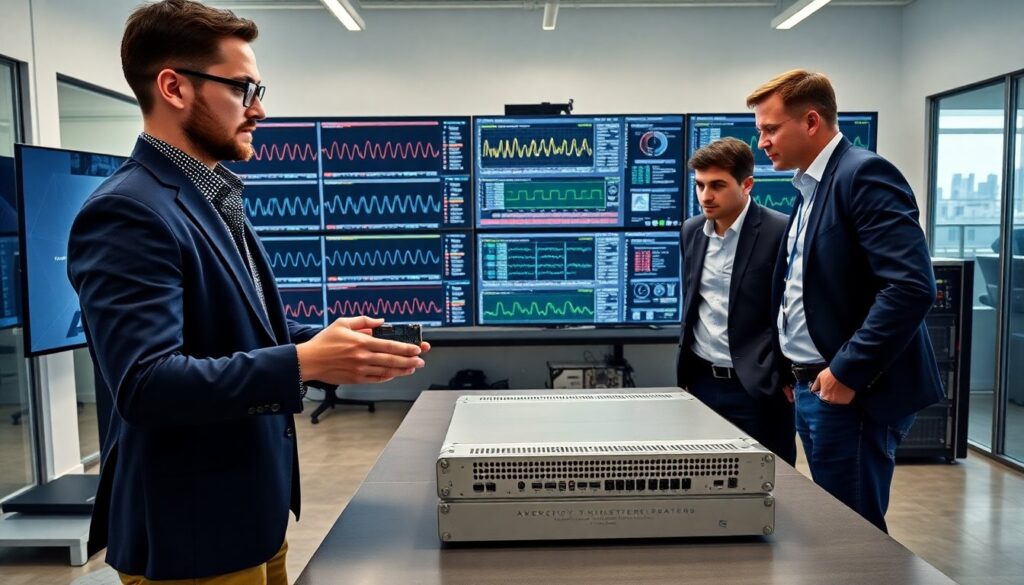
AeonScope includes three hardware classes: low-power loggers, industrial-grade modules, and high-speed capture cards. The loggers sample slowly for long deployments. The modules attach to machines and read vibration, temperature, and current. The capture cards record high-bandwidth signals like ultrasonic or RF. Each device embeds a clock and a small metadata store. The devices offer local filtering and trigger rules. Deployers select devices by sample rate, power profile, and environmental rating.
Data Output, Connectivity, And Integrations
AeonScope outputs compressed time-series files and a JSON metadata manifest. The platform supports MQTT, HTTP(S), and secure file transfer. Integrations include common databases, cloud object stores, and event buses. The system provides native connectors for analytics platforms and model training pipelines. Users can stream raw frames or work with preprocessed feature windows. The connectivity layer retries on failure and preserves ordering of packets. The integration layer maps fields to downstream schemas automatically.
Key Features, Performance Metrics, And Practical Benefits
AeonScope offers synchronized timestamps, adaptive sampling, and lossless buffering. The platform measures latency, packet loss, and effective sample fidelity. Typical latency ranges fall between tens of milliseconds and a few seconds depending on link quality. Packet loss remains near zero with redundant buffering. Practical benefits include faster root-cause analysis, better model accuracy from cleaner labels, and reduced manual data wrangling. Teams report lower mean time to detect and reduced false alarms when they use AeonScope data for analytics.
Who Should Use AeonScope? Use Cases, Limitations, And Buying Considerations
AeonScope suits teams that need long-duration, high-integrity signal records. Typical users include maintenance teams, research labs, and ML engineers training predictive models. The platform fits use cases such as condition monitoring, anomaly detection, and product testing. Limitations include higher initial hardware cost and a learning curve for edge configuration. Buyers should compare sample rate needs, deployment conditions, and integration targets. They should plan for power, mounting, and secure network access before purchase.
Pros, Cons, And Alternatives To Compare Before Deciding
Pros: AeonScope provides consistent time-series, strong metadata, and reliable buffering. Pros include modular sensors and native connectors for common analytics tools. Cons: AeonScope requires upfront setup and can cost more than simple loggers. Users must manage firmware and clock sync. Alternatives include basic IoT loggers and cloud-native telemetry agents. Buyers should weigh cost, signal fidelity, and long-term storage needs. Teams that need the highest data quality will find AeonScope worth the investment. Teams with tight budgets may choose cheaper loggers and accept lower fidelity.
More Stories
AI Predictive Analytics Showdown: Alonscopetirn Vs Koala — Which To Buy In 2026?
Aeon-Scoping.net: The Practical Guide To Scoping, Collaboration, And Results In 2026
AeonScoping.net Reviewed: What It Is, How It Works, And Who Should Use It (2026 Guide)